New fee may be found to be illegal

August 26, 2014

Our Public Service Board and water utility were formed in the 1950’s if my information is correct.  I do not know which Texas laws they operate under so my thoughts here may be inappropriate.  Maybe a reader will be able to better inform us.

Texas law allows municipal water utilities to assess charges for various purposes but they all seem to directly relate to the construction, maintenance, and operation of water distribution.  There are provisions that allow for fees for wastewater and storm water as well as water replacement.  Once again, all of the permitted charges appear to relate to water.

Our city council voted the other day to impose a charge on “non residential” customers of the water utility.  Council’s discussion clearly showed us that they wanted the fee for the city’s general fund, not for any water related activity.

I suspect that in the coming weeks we will see discussion about the nature of the new charge and whether the water utility can legally impose the bill on the “non residential” customers.  Listening to the city council meeting where this charge was discussed we can clearly see that their purpose in imposing the fee was to raise more revenue for the general fund, not to improve the water utility system.

We deserve better

Brutus


Another giveaway?

August 25, 2014

Well it looks like the onslaught will continue.

Our city government has decided that we need a new convention hotel in the downtown area.

In fact it looks like they want it so badly that they are willing to let us pay for it.

They have issued a request for proposals (RFP) asking that organizations submit proposals to build and operate a “250-room, full service, convention center hotel with a major national full-service lodging flag with related amenities and facilities”.  Further the hotel needs to have “a full-service three-meal restaurant”, “extended-hour room service”, “complimentary airport shuttle service”, and a “fitness center, pool and a bar/lounge”.

That sounds nice.  I wonder why someone has not built one yet.

The obvious reason it has not happened is that it is not economically feasible.

The city’s solution?  Let the city pay to build and operate the hotel.  We need it after all.  Just tell us how much money you need.

The fix is in

The RFP explains that the proposals will be graded with five evaluation factors.  A perfect proposal would receive 100 points.  The proposal with the most points wins.

The first factor is “Proven Ability of the Development Team”.  Proof will consist of ability to secure financing (for the part the city is not going to pay for), ability to meet the construction schedule, historic ability to complete projects of similar scale, and other things like references.

Second we will have “Financial Feasibility”.  How deep are their pockets?  Who runs the place?  What financial commitments are you capable of or willing to make?

“City Participation” is listed third.  In other words how much will the city have to cough up to build this hotel that no one wants to build without a handout?  The RFP incredibly does not say how much the city is willing to pay but instead asks the proposer to tell the city how much they will have to kick in.

“Development Schedule and Miscellaneous” is the fourth factor.  Have you ever built something in a hurry with no concern for economy?

Lastly we have “Preferred Subject Location”.  Proposals that would place the hotel within 1,000 feet of the civic center will get the most points.  Evidently anyone who does not already own the land they will use will have to be prepared to pay handsomely since the city has gone public and told the existing land owners to be ready to cash in.

Incredible

“City Participation” only counts for 15 points or 15% of the decision.  Money is no object–since the city can just send the taxpayers the bill.

Location counts for 25 points.  That gives the advantage to people who already own land in the 1,000 foot area.

Development schedule is just 10 points.

Proven Ability and Financial Feasibility each count 25 points for a total of half of the evaluation.

Easy selection

There are not a lot of choices here.  The city is basically telling one or two developers to just state their terms.  The city will pay whatever they want.

Keep quiet

Don’t call the Mayor or your city representative.  The RFP makes it a point to let us know that that would be illegal.  More on this in a future post.

We deserve better

Brutus


El Paso — What’s The Name Of The Game?

August 24, 2014

Those of us that contribute to elpasospeak.com encourage people to send material to us for publishing on the blog.  As always we like to avoid name calling and getting personal.  We also try to avoid profanity, although we sometimes allow it to get through in the comment process.

Today we have a piece from Mr. Jerry Kurtyka.  El Paso Inc. published this as his biography:

Jerry Kurtyka, a former banker and technology strategy consultant, has held several positions with the City of El Paso. He was the first executive director of the Housing Finance Corporation from 2003 to 2006 and most recently led the library’s Virtual Village computer literacy project from 2011 to August of 2013.  He is now semi-retired and involved with environmental advocacy.

Mr. Kurtyka’s article:

EL PASO – WHAT’S THE NAME OF THE GAME?

Remember the 1977 Abba song, “The Name of the Game”, that enjoyed a recent reprise in the hit musical, “Mama Mia”?

What’s the name of the game?

Does it mean anything to you?

What’s the name of the game?

Abba, The Name of the Game

Great feel-good music. I think of it when I ask myself about El Paso because I am the kind of person who looks for a rationale in events, a story that ties the threads together. If El Paso, were a song or movie or book, what would be its title? What’s the name of the El Paso game, assuming there is one? Does it mean anything, i.e., does it explain what we are seeing?

Since I have been here (1996), I have observed several stories emerge that community leaders used to spin a narrative to support their policy actions, like the recent AAA stadium. These stories are important because the city and others have invested and continue to invest millions in them, consciously or not. But we are always captive to our past narratives, so when we invest in a new story, what happens to the old one? Unless consciously acknowledged, it will continue to live alongside the new stories we tell ourselves, even if it has to go underground to do so.

Well, Brutus and Cicero have asked me to put some of my thoughts together on the subject and have kindly offered a little space to do so. I admit at 68 that I have a kind of dystopian worldview. So here it goes for several pieces to describe what I think are the games or stories El Paso has played and still plays, plus a few positive ideas on how a new story might yet emerge here.

Game #1 – Don’t Put on Any Airs (Low Wages)

Just after I moved here in 1996, I attended a class at UTEP to learn about the local economy. The professor, whose name I can’t recall, explained that in the 1970s, business leaders here promoted El Paso around the country as a low wage resource for manufacturing, such as the piece-rate model of the garment industry. Apparently, they succeeded beyond their dreams, because 40 years later, El Paso is still a pretty low wage place if average household income is any guide. Back then, migrants from Mexico flooded in bringing few skills and education with them. It worked in the garment plants until NAFTA resulted in our manufacturing tax base migrating across the river and El Paso was left holding the bag.

The problem with positioning yourself on a low rung of the economic ladder is that there are places in the world where the ladder rungs go even lower, such as Asia or Central America, and the garment industry migrated to these places. Just look at the label on your shirt. By the end of the 90s, the garment business was abandoning even “low cost” El Paso for lower wage countries, leaving thousands of mostly unskilled, poorly-educated workers unemployed and with few prospects to replace what they had lost. There was nothing here for them to move up the ladder. I mean, who wants to go back to Mexico?

Lesson learned? Next time you send out invitations to your game, think about who might show up and what happens when the game ends, because nothing lasts forever.

When you’re lost in the rain in Juarez

And it’s Eastertime too

And your gravity fails

And negativity don’t pull you through

Don’t put on any airs

Bob Dylan, Just Like Tom Thumb’s Blues


Pay me and I’ll let you know what I decide

August 23, 2014

Our city council created the “Hire El Paso First” local business purchasing preference policy.  Good work.

Pay to play

Actually a local business has to enroll in the program and pay an application fee of $150 dollars.  Maybe the purchasing department does not know who the local businesses are or how to prove that they are local.

What does a business get for their $150 payment?  They could get up to a 5 point evaluation  advantage over an out of town business.

Unless

Unless, according to the city web site, the city choses to use a buy board, or the purchase is for telecommunication or information services, or if there will be a construction contract for over $100,000.  Maybe local businesses aren’t good enough to compete for larger jobs.

Another exemption from the program is when the city decides not to buy from the local bidder.

This sounds like extortion to me.

We deserve better

Brutus


Above the law?

August 22, 2014

The Max Powers blog published an article the other day titled “Hawaiian Hardball”.

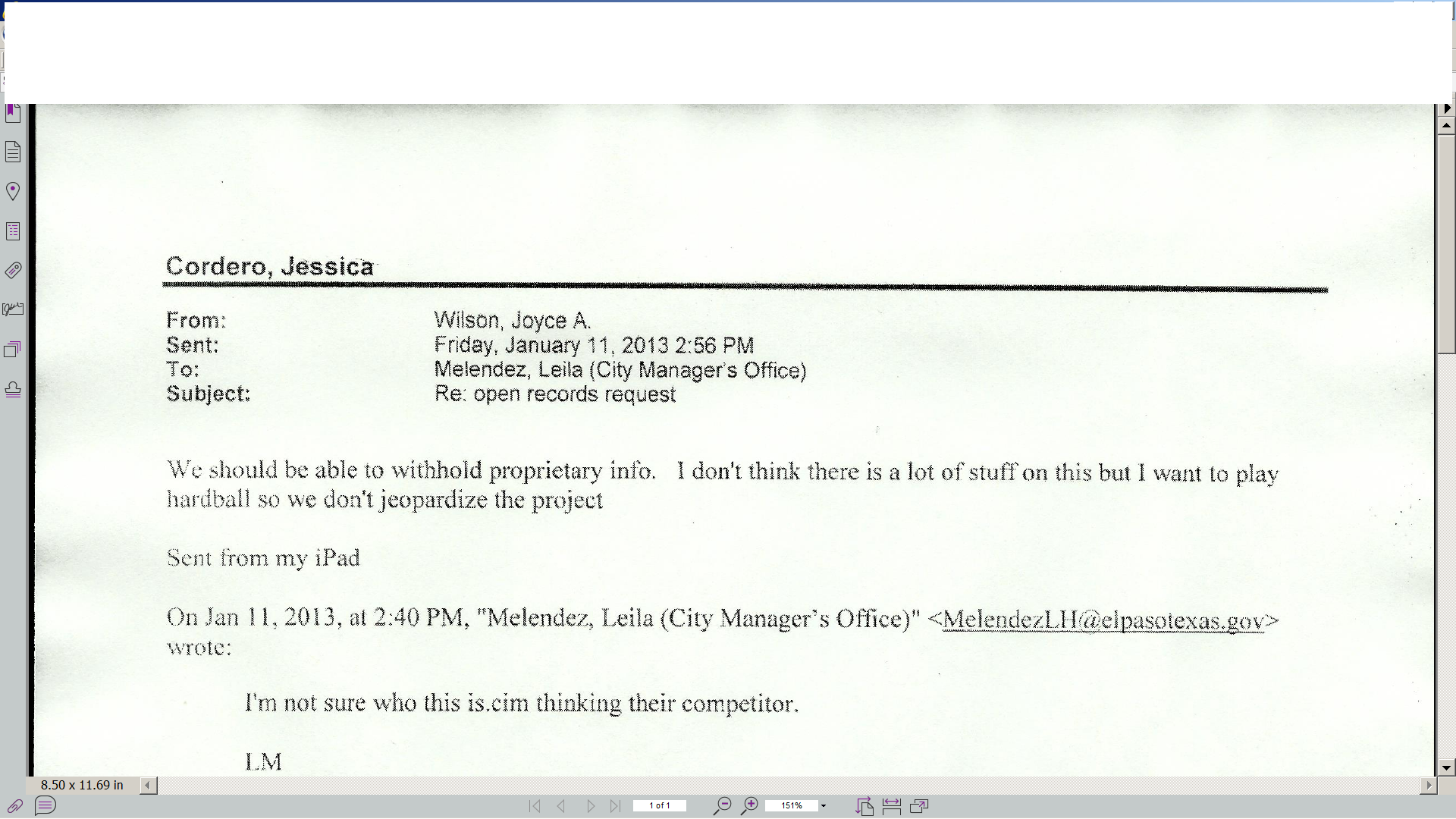
The article contained a link to an email from the former city manager instructing the city staff to play “hardball” with an open records request relating to a potential water park.

It looks as though the city was negotiating with a organization and received an offer from the firm.  Then someone (probably a competitor) filed an open records request asking for access to the offer.  You can read the email below:

hardball

Power hungry

In the email we learn that the city manager wanted “to play hardball” with the proprietary portion of the offer.  She did not want to release that material so she decided to use her power and “play hardball”.

If she cared just a little bit about the law she would have known that the city did not have to nor should it have released the proprietary material, so she did not need to play hardball.  She just wanted to.

The Texas Public Information Act gives specific instructions to governments requiring them to notify the owner of the proprietary material and giving the owner an opportunity to object to the release before releasing documents like these.  If an objection was raised the city would then have to take the issue to the attorney general of Texas for a determination.

The general principal is that while negotiations are still being conducted no party should have access to information that would give them a competitive advantage.  How the city might have proceeded with the offer is another issue.

Mean spirited

The city did not have to play hardball.  They simply could have obeyed the law.  I wonder if she knew that.

We deserve better

Brutus