EL PASO – WHAT’S THE NAME OF THE GAME? #4

September 8, 2014

 This from Jerry Kurtyka:

Game #4 – Shock and Awe (Disaster Capitalism)

“…a military doctrine based on the use of overwhelming power, dominant battlefield awareness and maneuvers, and spectacular displays of force to paralyze the enemy’s perception of the battlefield and destroy its will to fight.”

  • Wikipedia definition for Shock and Awe.

Sound familiar? On June 26, 2012, CC met to consider resolutions for the demolition of city hall and the construction of a AAA stadium in its place financed by the city through an increase in the hotel occupancy tax (HOT). This was supposedly an example of the “public/private” partnership model mentioned in the Downtown Plan, but one where the public had a supermajority of the cost, debt and risk and the private party, Mountainstar, kept a supermajority of the revenues. For many El Pasoans, this came as a shock – out of the blue, so to speak – a political and financial coup d’etat. But not to everyone.

Cindy Ramirez, reporting in the El Paso Times on July 27, 2012, quoted then city manager Joyce Wilson as saying, “The perception is that there was no transparency, and that is absolutely not true,” said Wilson, who added that the possibility of a baseball team and a new stadium had been discussed for about two years. “I believe it’s the most extensive analysis anyone has ever done on any project in the city.”

Clearly, Wilson’s idea of transparency was that everyone who needed to know about it was in the loop, just not the people who were slated to pay for it! The downtown plan several years before that, at least, had a public comment period before it was adopted. The announcement of June 26th was followed by a publicity blitz and full-court press from the PDNG on local media to support the AAA stadium and downplay opposition to it.

It was like a runaway train as the spin from city hall, the Times, PDNG and the team owners spilled forth. It affected us personally when I understood that Insights Museum was to be demolished. My wife was Insight’s interim director at the time and had recently turned the museum around financially. A smear campaign against Insights unfolded when vigorous local support for the museum surfaced with resistance to its demolition, not anticipated by PDNG or Wilson. Insights was a Smithsonian-certified museum that cost the city nothing and was the only STEM education facility for children in town with over 33,000 students visiting it annually. The El Paso Explorium (Lynx Exhibits, a kind of Chuck-E-Cheese version of a museum) was floated in the Times as a temporary location for Insights until the promised Children’s museum materialized from the proposed 2013 QoL bond issue. The EP Times building was slated to replace city hall and an “appraisal” was done by Russ Vandenberg setting its value at over $10MM. CC did not propose a lower price or question the appraisal, even though there was virtually no market for downtown properties; it was a done deal. The spin said we had to act quickly or risk losing the team.

Joe Meunch of the Times coined the term, “crazies” to describe those opposed to the deal (of which the Times was the largest single beneficiary), a term later picked up on by the city manager and prominent local blogger, David Karlsruhe. The city’s CFO presented a business case for the stadium showing a cost of $48MM and a breakeven level of operation.

Everyone was on message. It was Shock and Awe El Paso style, all in only a month!

Two town hall meetings were held and I attended one at the West Side Regional Command Center where Rep. Niland, Wilson and deputy city manager, Debbie Hamlin, tried to explain the deal. People were furious and a straw poll of the audience showed 90% opposed to the deal (though I don’t think to AAA or even to a stadium; more to how it was done and the loss of city hall). Someone asked Niland and Wilson if they were members of PDNG, which they initially denied, but Wilson backtracked to say they were “honorary members.” It was clear who was running our city government. Even The Inc., that normally sides with the movers and shakers, covered the town hall meetings in a piece titled, “Stadium Rage,” and printed a guest editorial by former mayor, Larry Francis, who opposed the stadium. The opposition couldn’t be ignored any longer.

Like me, many were left wondering how this could have happened. We voted to hire a city manager to bring El Paso into the 21st century because back room style cronyism had defined governance here for generations. Now, in the irony of ironies, Joyce Wilson orchestrated the biggest backroom crony deal in the city’s history. It would not surprise anyone today if the city manager form of organization is repealed in a future charter election, a fitting legacy for Wilson. At least when we have a corrupt mayor, we can fire him every four years!

It was all legal. Subsequent open records requests revealed a trail of suck-up to the stadium pimps by Wilson, who appeared to literally represent their interests over the interests of the city. But it was all legal; just not ethical.

In April 2013, I was at a conference in Taos and watched the demolition of city hall on my laptop. I asked myself, how could an elected government decide that the city was so lacking amenities that it was worth it to destroy the trust between government and citizen, trash the careers of otherwise promising young leaders (Steve Ortega), and plunge the city into levels of debt and spending it never had before, and which benefited mostly only a few wealthy investors?

It is called Disaster Capitalism: the opportunism we see after a hurricane or earthquake when favored corporations rush into the catastrophe to rebuild and line their pockets on no-compete contracts. Leaders exploit the crises to push through exploitative policies while citizens are too distracted by the disaster to mount an effective resistance. Only in El Paso, we manufactured the disaster. We are our own Hurricane Sandy! Ask yourself, “Cui Bono?” Who benefits?

The stadium was the start of other big-ticket vanity projects, too. The trolley to nowhere will now be built, a soccer team and new stadium are being floated by Mountainstar, and an $85MM downtown arena is on the drawing board. Who will use it, since El Paso isn’t exactly on the stopover list for Lady Gaga or Justin Bieber? None of these projects have a business plan to pay for them. Watch for another demolition, perhaps of the Haskins Center, Cohen Stadium or the County Coliseum. Disaster capitalism is here to stay unless we take back our city government.

Lessons learned? Where are the adults in our local government? It is as if, someone – not an elected rep, but their sponsor- has the Big Idea. It gets legs, and the next thing you know we are spending mega-bucks on it with no plan to pay for it, other than generalities like, “Trolleys have a 10:1 return via increased property values along their route.“ I mean, the city lost $500K on the stadium in its first season and it was a sell-out almost every game! The city’s theory-of-change is that vanity projects will raise property values and sales taxes that will then pay for their cost. Not! Revenues need to pay for projects, not taxes. This town is already taxed to death and it is the poorest large city in Texas. We can’t run the city this way; we need a new direction.

NEXT – Game’s Over (What Do We Do Now?)


Game #3 – Give Me Land (Growth)

September 4, 2014

This from Jerry Kurtyka:

EL PASO – WHAT’S THE NAME OF THE GAME?

Game #3 – Give Me Land (Growth)

Oh, give me land,

Lots of land under starry skies above,

Don’t fence me in…

        • Music by Cole Porter, lyrics by Robert Fletcher

El Paso is a growing city. OK, maybe it isn’t the hip, green growth you’d like to see, but then it isn’t Cleveland, OH either that suffered a population decline of 17% between 2000 and 2012 versus El Paso’s 15% growth in the same period. I chose Cleveland as a comparison because it is typical of the urban industrial north – the Rust Belt – and in the same general size category as El Paso. El Paso has younger demographics, too. Believe me, Cleveland would like our kind of “problems” as they are having a hard time just keeping the people they have there and burying the old ones who stick around.

Housing has grown here, too, with single family units increasing every year as well as multi-family units. Also, business establishments and overall employment are growing led by government, military and healthcare. Household and per capita income lag national averages, but are steadily improving.

Educational attainment is also improving with about 25% of adults now holding a 4-year degree or better here in 2010 (cf Austin at 62%), compared to 18% in 2000. I suspect that UTEP’s throwing out SAT scores and lowering admission criteria to a diploma and a pulse helped this to happen, but it is still an improvement.

Even Juarez is growing, though population growth has flattened in recent years. But the other economic stats look pretty good for a 3rd world city.

So what’s the problem and why are we so angry with each other? Is growth what we really want? Or is it that we want a say in how we grow, who pays for growth and who benefits from it?

In 1999, the city authorized a Quality of Life (QoL) bond issue that built new libraries and a museum, among other improvements. By 2003, when I became the first Executive Director of the Housing Finance Corporation (HFC), a conversation was beginning in city hall about growth and how it is paid for. I had an interest in this because the HFC’s bond money financed 300-400 homes each year, many of which were new homes. Mayor Joe Wardy was concerned about building standards in the unincorporated areas that might eventually be annexed by the city, leaving the city on the hook to upgrade their infrastructure and amenities. The complexion of city council (CC) was changing, too, as so-called progressives like Steve Ortega and Beto O’Rourke were seated, the first city manager was hired, the Paso del Norte Group (PDNG) was formed and people started talking about the city’s future, especially BRAC and Fort Bliss.

Water became a big issue then as it was the key for any future growth. The PDNG did a water study, as did the builders (fair disclosure: I was a member of PDNG that year and was on this committee). No one was really an expert and in the end it came out that there is a lot of water under El Paso, but most of it is brackish and needs treatment. So the water issue was taken off the table for a while as a growth inhibitor and a desalinization plant on the east side was planned to add capacity and guarantee Fort Bliss that its soldiers wouldn’t go thirsty.

It was in this period, around 2005 I think, when Joyce Wilson brought in the urban scholar, Richard Florida (The Rise of the Creative Class), to tell the local power elite how downtown El Paso could be gentrified. PDNG managed to get the city to put up $250K and the Feds put up another $250K to hire a tony west coast planning firm to create a downtown plan that, of course, was done in secret by the PDNG. Nor was it the first such downtown plan, but it is the one we are currently operating from if you have wondered where the ideas for an arena, museum district and artist studio apartments came from. Really, it is a good plan if you compare it to no plan. But it doesn’t address who pays and who benefits other than vague “public/private” rubrics and TIF and TIRZ.

Out of this milieu, a special city council meeting was called to address growth and its financial impact. A study was prepared by the city that reportedly showed the cost of new homes to the city and how subsequent property tax would offset (or not) the requisite infrastructure. Some people, myself included, were thinking, why do we need a QoL bond issue when new homes should be paying the capital cost for infrastructure and amenities like libraries, parks, police and fire stations, etc.? Well, the builders were thinking that they did not want to pay the connection fees that many other cities charge new homes to fund these necessities up front, but to load them onto the general tax base.

Eventually, some connection fees were mandated and the matter to increase fees recently came up again in CC, but was tabled to a future date. This is the hot potato of development here and, IMHO, the reason why development has not paid for itself in El Paso and why we need a QoL bond issue to play “catch-up” every ten years. It goes double for downtown that pays little or no property tax. We play this Ponzi scheme with growth, privatizing its benefits and shoving its cost onto the next bigger fool who, ultimately, is the homeowner.

That study is nowhere to be found today and I still hear people quoting its findings, except they are unable to point to any actual document. The one thing that could be said of the study is that an amateur did it, someone with no experience in the complex economics of urban development. (Does this remind you of the stadium business case?) You would think that, in a matter as important as the cost of new urban physical growth in which billions of dollars are at stake over a span of years, the city would hire an independent advisor with some real expertise, e.g., the Urban Land Institute. Maybe they wanted someone whose findings they could control? Instead, we paid Richard Florida to tell us we need more hipsters downtown (a cheap shot on my part, I admit; Florida has more to say that I will address in a later post).

Even Gary Sapp of Hunt Development said as much about the study in a special meeting hosted by Beto O’Rourke back then to present Hunt’s philosophy on large, master planned development as an alternative to the kind of piecemeal, unplanned development in practice here and supported by the local builders. I attended this meeting in the 8th floor conference room of city hall, right outside my HFC office. Say what you want about Hunt, Mr. Sapp knew his stuff and spoke a lot more common sense than I was hearing from the builders and the city.

Growth lessons learned? Growth is better than decline; no one disagrees with that. But in El Paso, the game around growth is who controls its direction and who pays for it. We have seen the city fudge numbers to make the cost of growth (and a stadium) appear less than it is in order to shift the cost away from the private sector and onto the general tax base. More strategically, it is important for citizens here to not underestimate the value to investors of El Paso’s growth, especially in a post-TARP era of retrenchment all over the world. Just compare El Paso to Cleveland and Detroit! Real economic growth – not paper bank assets – is rare and precious and there are people here who understand this and they want to control El Paso’s growth, benefit from it and to make you pay for its cost on their behalf. When you point this out to them and to their confederates, you are called a “Crazy.


More sleight of hand

August 30, 2014

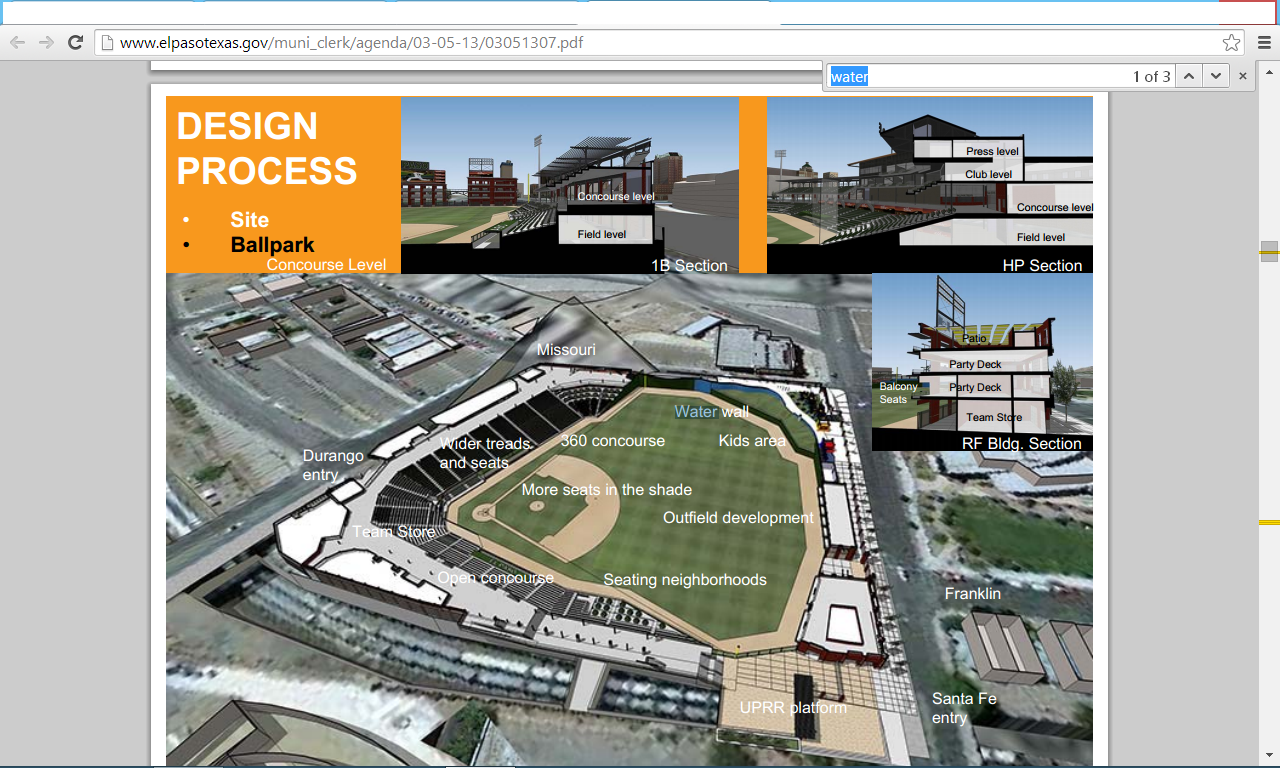
Not that we should have expected anything different, I was wondering about the water wall at our new baseball stadium.

waterwall

The slide above is one of many that were presented to us.

If anyone has seen the water wall I would appreciate being corrected.

We deserve better

Brutus


El Paso — What’s The Name Of The Game?

August 24, 2014

Those of us that contribute to elpasospeak.com encourage people to send material to us for publishing on the blog.  As always we like to avoid name calling and getting personal.  We also try to avoid profanity, although we sometimes allow it to get through in the comment process.

Today we have a piece from Mr. Jerry Kurtyka.  El Paso Inc. published this as his biography:

Jerry Kurtyka, a former banker and technology strategy consultant, has held several positions with the City of El Paso. He was the first executive director of the Housing Finance Corporation from 2003 to 2006 and most recently led the library’s Virtual Village computer literacy project from 2011 to August of 2013.  He is now semi-retired and involved with environmental advocacy.

Mr. Kurtyka’s article:

EL PASO – WHAT’S THE NAME OF THE GAME?

Remember the 1977 Abba song, “The Name of the Game”, that enjoyed a recent reprise in the hit musical, “Mama Mia”?

What’s the name of the game?

Does it mean anything to you?

What’s the name of the game?

Abba, The Name of the Game

Great feel-good music. I think of it when I ask myself about El Paso because I am the kind of person who looks for a rationale in events, a story that ties the threads together. If El Paso, were a song or movie or book, what would be its title? What’s the name of the El Paso game, assuming there is one? Does it mean anything, i.e., does it explain what we are seeing?

Since I have been here (1996), I have observed several stories emerge that community leaders used to spin a narrative to support their policy actions, like the recent AAA stadium. These stories are important because the city and others have invested and continue to invest millions in them, consciously or not. But we are always captive to our past narratives, so when we invest in a new story, what happens to the old one? Unless consciously acknowledged, it will continue to live alongside the new stories we tell ourselves, even if it has to go underground to do so.

Well, Brutus and Cicero have asked me to put some of my thoughts together on the subject and have kindly offered a little space to do so. I admit at 68 that I have a kind of dystopian worldview. So here it goes for several pieces to describe what I think are the games or stories El Paso has played and still plays, plus a few positive ideas on how a new story might yet emerge here.

Game #1 – Don’t Put on Any Airs (Low Wages)

Just after I moved here in 1996, I attended a class at UTEP to learn about the local economy. The professor, whose name I can’t recall, explained that in the 1970s, business leaders here promoted El Paso around the country as a low wage resource for manufacturing, such as the piece-rate model of the garment industry. Apparently, they succeeded beyond their dreams, because 40 years later, El Paso is still a pretty low wage place if average household income is any guide. Back then, migrants from Mexico flooded in bringing few skills and education with them. It worked in the garment plants until NAFTA resulted in our manufacturing tax base migrating across the river and El Paso was left holding the bag.

The problem with positioning yourself on a low rung of the economic ladder is that there are places in the world where the ladder rungs go even lower, such as Asia or Central America, and the garment industry migrated to these places. Just look at the label on your shirt. By the end of the 90s, the garment business was abandoning even “low cost” El Paso for lower wage countries, leaving thousands of mostly unskilled, poorly-educated workers unemployed and with few prospects to replace what they had lost. There was nothing here for them to move up the ladder. I mean, who wants to go back to Mexico?

Lesson learned? Next time you send out invitations to your game, think about who might show up and what happens when the game ends, because nothing lasts forever.

When you’re lost in the rain in Juarez

And it’s Eastertime too

And your gravity fails

And negativity don’t pull you through

Don’t put on any airs

Bob Dylan, Just Like Tom Thumb’s Blues


Too many chiefs

August 6, 2014

We are now down to one working deputy city manager out of four positions.

Things seem to be settling down.

Less is more

Maybe we don’t need deputy city managers.  We have a chief of police, a fire chief, a comptroller, and various department heads.

What did we get with deputy city managers?

The one in charge of transportation got us the new rapid transit system on Mesa, the street cars that go to the wrong places, the coming bicycle rental system, and countless streets that either are in dire need of paving or are under what feels like permanent reconstruction.

Our chief financial wizard helped us tear down city hall and spend countless millions refurbishing multiple buildings.  Citizens have to travel to multiple buildings for services and we have even used space in a community center to house a city department.  Our public safety pension funds are floating in red ink.  Bond spending has skyrocketed with the promise that revenues will pay for them.  We have the bonds but not the revenues.

One former deputy city manager got us the ball park, the beginning of a downtown renaissance.

Another brought us a multi-million dollar digital wall, soon to be one of only two in the world.

Maybe these people thought that they were supposed to do something other than give us an efficient city government.  Maybe they actually thought their job was to create massive public works projects in the name of progress.

Savings

It seems to me that we could save a lot of money here.  First we have the salaries, termination agreements, and pension obligations of the deputies.  Then we have their offices and staffs.  Then we have the mischief they cause.

We have department heads.  Why can’t they run their departments?

The new city manager might want to do some reorganization.  Creating a director of public works might be a good idea.  Strategic sourcing could be transformed back into purchasing.  You get the idea.

We deserve better

Brutus