This from Jerry Kurtyka:
EL PASO – WHAT’S THE NAME OF THE GAME?
Game #3 – Give Me Land (Growth)
Oh, give me land,
Lots of land under starry skies above,
Don’t fence me in…
- Music by Cole Porter, lyrics by Robert Fletcher
El Paso is a growing city. OK, maybe it isn’t the hip, green growth you’d like to see, but then it isn’t Cleveland, OH either that suffered a population decline of 17% between 2000 and 2012 versus El Paso’s 15% growth in the same period. I chose Cleveland as a comparison because it is typical of the urban industrial north – the Rust Belt – and in the same general size category as El Paso. El Paso has younger demographics, too. Believe me, Cleveland would like our kind of “problems” as they are having a hard time just keeping the people they have there and burying the old ones who stick around.
Housing has grown here, too, with single family units increasing every year as well as multi-family units. Also, business establishments and overall employment are growing led by government, military and healthcare. Household and per capita income lag national averages, but are steadily improving.
Educational attainment is also improving with about 25% of adults now holding a 4-year degree or better here in 2010 (cf Austin at 62%), compared to 18% in 2000. I suspect that UTEP’s throwing out SAT scores and lowering admission criteria to a diploma and a pulse helped this to happen, but it is still an improvement.
Even Juarez is growing, though population growth has flattened in recent years. But the other economic stats look pretty good for a 3rd world city.
So what’s the problem and why are we so angry with each other? Is growth what we really want? Or is it that we want a say in how we grow, who pays for growth and who benefits from it?
In 1999, the city authorized a Quality of Life (QoL) bond issue that built new libraries and a museum, among other improvements. By 2003, when I became the first Executive Director of the Housing Finance Corporation (HFC), a conversation was beginning in city hall about growth and how it is paid for. I had an interest in this because the HFC’s bond money financed 300-400 homes each year, many of which were new homes. Mayor Joe Wardy was concerned about building standards in the unincorporated areas that might eventually be annexed by the city, leaving the city on the hook to upgrade their infrastructure and amenities. The complexion of city council (CC) was changing, too, as so-called progressives like Steve Ortega and Beto O’Rourke were seated, the first city manager was hired, the Paso del Norte Group (PDNG) was formed and people started talking about the city’s future, especially BRAC and Fort Bliss.
Water became a big issue then as it was the key for any future growth. The PDNG did a water study, as did the builders (fair disclosure: I was a member of PDNG that year and was on this committee). No one was really an expert and in the end it came out that there is a lot of water under El Paso, but most of it is brackish and needs treatment. So the water issue was taken off the table for a while as a growth inhibitor and a desalinization plant on the east side was planned to add capacity and guarantee Fort Bliss that its soldiers wouldn’t go thirsty.
It was in this period, around 2005 I think, when Joyce Wilson brought in the urban scholar, Richard Florida (The Rise of the Creative Class), to tell the local power elite how downtown El Paso could be gentrified. PDNG managed to get the city to put up $250K and the Feds put up another $250K to hire a tony west coast planning firm to create a downtown plan that, of course, was done in secret by the PDNG. Nor was it the first such downtown plan, but it is the one we are currently operating from if you have wondered where the ideas for an arena, museum district and artist studio apartments came from. Really, it is a good plan if you compare it to no plan. But it doesn’t address who pays and who benefits other than vague “public/private” rubrics and TIF and TIRZ.
Out of this milieu, a special city council meeting was called to address growth and its financial impact. A study was prepared by the city that reportedly showed the cost of new homes to the city and how subsequent property tax would offset (or not) the requisite infrastructure. Some people, myself included, were thinking, why do we need a QoL bond issue when new homes should be paying the capital cost for infrastructure and amenities like libraries, parks, police and fire stations, etc.? Well, the builders were thinking that they did not want to pay the connection fees that many other cities charge new homes to fund these necessities up front, but to load them onto the general tax base.
Eventually, some connection fees were mandated and the matter to increase fees recently came up again in CC, but was tabled to a future date. This is the hot potato of development here and, IMHO, the reason why development has not paid for itself in El Paso and why we need a QoL bond issue to play “catch-up” every ten years. It goes double for downtown that pays little or no property tax. We play this Ponzi scheme with growth, privatizing its benefits and shoving its cost onto the next bigger fool who, ultimately, is the homeowner.
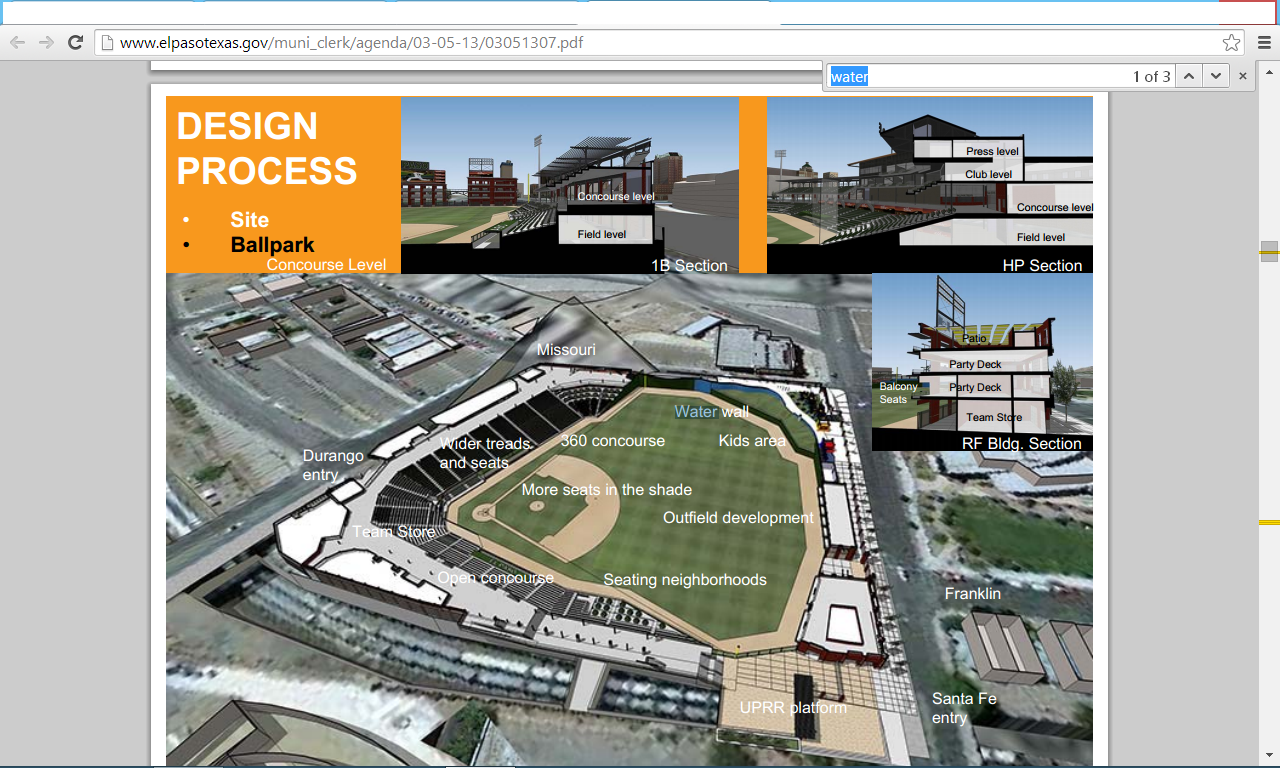
That study is nowhere to be found today and I still hear people quoting its findings, except they are unable to point to any actual document. The one thing that could be said of the study is that an amateur did it, someone with no experience in the complex economics of urban development. (Does this remind you of the stadium business case?) You would think that, in a matter as important as the cost of new urban physical growth in which billions of dollars are at stake over a span of years, the city would hire an independent advisor with some real expertise, e.g., the Urban Land Institute. Maybe they wanted someone whose findings they could control? Instead, we paid Richard Florida to tell us we need more hipsters downtown (a cheap shot on my part, I admit; Florida has more to say that I will address in a later post).
Even Gary Sapp of Hunt Development said as much about the study in a special meeting hosted by Beto O’Rourke back then to present Hunt’s philosophy on large, master planned development as an alternative to the kind of piecemeal, unplanned development in practice here and supported by the local builders. I attended this meeting in the 8th floor conference room of city hall, right outside my HFC office. Say what you want about Hunt, Mr. Sapp knew his stuff and spoke a lot more common sense than I was hearing from the builders and the city.
Growth lessons learned? Growth is better than decline; no one disagrees with that. But in El Paso, the game around growth is who controls its direction and who pays for it. We have seen the city fudge numbers to make the cost of growth (and a stadium) appear less than it is in order to shift the cost away from the private sector and onto the general tax base. More strategically, it is important for citizens here to not underestimate the value to investors of El Paso’s growth, especially in a post-TARP era of retrenchment all over the world. Just compare El Paso to Cleveland and Detroit! Real economic growth – not paper bank assets – is rare and precious and there are people here who understand this and they want to control El Paso’s growth, benefit from it and to make you pay for its cost on their behalf. When you point this out to them and to their confederates, you are called a “Crazy.


 Posted by Brutus


You must be logged in to post a comment.