No cures today

January 2, 2015

The Times finally got around to writing a piece about our county hospital and the failing grade that the folks at Medicare gave them.

Some of you might not have emerged from the fog caused by the new year  celebrations so let us help translate the article.

You should be able to see what is coming when you read the sub-title of the article:

“UMC officials say penalty may reflect challenge of treating the unisured and very ill”– In other words UMC is different than other hospitals.  Our patients are sick, they are dirty, they are poor.

Then the damage control continues:

“University Medical Center officials, who were notified last week about the penalty related to “hospital-acquired conditions,” on Monday confirmed that the Centers for Medicare and Medicaid Services (CMS) reduction will amount to 1 percent of the hospital’s total Medicare payment for fiscal year 2014-2015, which began Oct. 1.”–  We didn’t know about this when we gave out those bonuses earlier this year although the report is for problems that occurred last year.

“We may appeal the penalty once we complete the review,” said Javier Gonzalez, UMC’s director of quality management. “This is a new program, and this has never happened before.”– This isn’t fair, we didn’t know that we were supposed to make patients well, not make them sicker.

“UMC officials said they believe the penalty may reflect the kind of patients that the teaching hospital is likely to treat.”– Only really horrible people go to teaching hospitals.

“They’re so sick when they come to us that they require prolonged hospitalizations, which studies have shown can lead to hospital-acquired infections or conditions (HAC’s),” Garcia said. “Our trauma patients arrive with deep wounds, multiple fractures, and they might develop blood clots and require multiple surgeries.”– We don’t know what to do.  How did the other thousands of hospitals in the study avoid these problems?  Bellevue in New York received a passing grade.

UMC officials said the Medicare penalty involved potentially 18 out of 33,598 patients between January 2012 and December 2013 that reportedly developed serious complications.”– We didn’t hurt that many people.

“Garcia said that UMC will review the concerns that federal regulators identified to determine if there are any root causes that the hospital needs to address, such as staff training to include nurses and doctors.”– We might not change anything, this will probably blow over.  Besides we can always make up for the revenue loss by raising taxes.

“Gonzalez said, “We will continue to deliver unparalleled care and remarkable patient outcomes.””– Please don’t continue.  Unparalleled?  Remarkable?  Being one of only a dozen or so hospitals out of thousands to receive the worst possible score is certainly unparalleled and remarkable.

“Lorena Navedo, UMC executive chief of staff, said the American Hospital Association and Dr. Ashish Jha, an expert at the Harvard School of Public Health, assert that teaching hospitals and others hospitals that treat the sickest patients were disproportionately hit with Medicare penalties for HAC’s.”– Our doctors are just trainees, you are the one that decided to use amateurs.

“The American Hospital Association said the HAC Reduction Program is “a poorly designed policy that unfairly penalizes hospitals that care for the sickest patients,” and urged the CMS to consider changes in its scoring methods.”– There are over 1,000 teaching hospitals in the United States.  Only a dozen or so hospitals scored as badly as our hospital, and not all of the dozen are teaching hospitals.

Our public relations person at the county hospital recently left.  Could the Times reporter be auditioning for the job?

We deserve better

Brutus


Nor any drop to drink

January 1, 2015

We start off the new year with a post from a new (to us) author Helen Marshall but not until we take the opportunity to wish you a healthy and prosperous new year and to thank all of you for your involvement.


What, us worry?

The Times has recently printed a series of articles that described various aspects of the drought facing the region and questions of how to continue supplying adequate water to the city. El Paso Water Utilities has also embarked on a campaign to convince us that, while water supply is not a simple matter any longer, “purified water” – i.e., recycled sewage – along with water piped from Hudspeth County, will ensure “Water Forever” as the EPWU slogan has it.

UTEP Economics professor Tom Fullerton ran a three-pronged offense over the weekend of December 27-18, to reassure everyone that “EPWU has met the challenge of providing quality water services in El Paso’s desert environment while operating efficient, reliable facilities that keep pace with the city’s growth. . [P]rudent management, continued planning, and innovative technologies will yield long-term solutions that benefit the local economy, environment, and quality of life.”

All three local papers printed his column, a first as far as this writer knows. Readers presumably are reassured that El Paso can continue growing, and water will be provided (at a reasonable price, yet!).

While the EPWU has indeed led the way on conservation in Texas and the region, we have yet to hear how much growth we can continue to shove into the Paso del Norte (where the neighboring city uses the same aquifer), regardless of the projected continuing drought. (Fullerton does not address the river that is missing for much of the year as its waters largely disappear into the pecan farms and cotton fields.) How much water is being removed from the aquifers and not returned now? How much worse will this be when we are drinking our “recycled water” rather than using it for recharge? As we carpet the desert with impermeable parking lots and structures, how much worse does the flooding problem become? Perhaps we must just learn to live next to the Big Ditch and not worry about that part of our quality of life. And the good news is that there will be an ever-larger supply of attendees for the Ballpark!

If we buy this story, do we deserve better?

http://www.elpasotimes.com/water

http://www.elpasoinc.com/news/local_news/article_a436c3ca-8f76-11e4-aa76-c3ace90cf2e0.html

http://www.elpasotimes.com/opinion/ci_27217287/el-paso-water-utilities-is-planning-leader

http://diario.mx/Opinion_El_Paso/2014-12-27_521b96a7/epwu-la-eficiencia-en-el-desierto/


Is there something personal here?

December 30, 2014

The other day the Times printed an article about a well known businessman who has declared bankruptcy.

The businessman was trying to get our border governments to adopt a system that would dramatically reduce the time required (and thus the cost) to import items from our maquiladoras into the United States.  Ever the optimist, he evidently underestimated the difficulties in getting the multiple bureaucrats to work together for the good of the community.

The story probably deserved an article based on the fame and likability of the entrepreneur.

A second article that discusses the dispute between him and one of his creditors has just been published.  While the Times continues to ignore much bigger stories relating to the problems with our local governments it somehow has found reason to air this private dispute.

Why?  Does someone at the Times have reasons for digging into this when we have many more important problems that they are ignoring?  Is the Times once again trying to use it’s readership to help an individual?

We deserve better

Brutus


Which time?

December 28, 2014

The advent of the electronic version of the El Paso Times has validated  the old maxim “don’t believe everything that you read”.

In the past when paper was the only way to read their stories if a mistake was made the Times would sometimes print a clarification or retraction in a subsequent edition.

With the electronic versions they seem to feel free to change their stories at will with no notification to their readers that an earlier version has been changed.

The story of the boy scout land lease the other day is an example.  The original version of the story looked like this on the electronic version:

boyscoutsi35

The article went on with this quote “It will be used as one of the largest urban Boy Scout camps in the United States, transportation commission Chairman Ted Houghton said earlier this week.”

Talk about an understatement

With the land bordered by Paisano drive and Interstate 35 this will be one large campground.

Later in the day a visit to the same web site provided this snapshot:

boyscouts10

The mistake in the earlier version is not what bothers me.  It is that the Times feels no need to let it’s readers know that they published something that was wrong and then provide the correct information.

How can we trust what they print?

We deserve better

Brutus


Searching for the truth

December 20, 2014

We try to be factually accurate here at elpasospeak.com.

While figuring out what to write about the problems at Ascarate lake I wanted to refer to an article the Times published months ago.  I went to their web site and entered “Ascarate pump” in the search box.  This is what I got:

ascarate1

I definitely remembered reading an article so I went ahead and clicked on “Search Our Archives”.  I entered “Ascarate pump” again and this is what was returned:

ascarate2

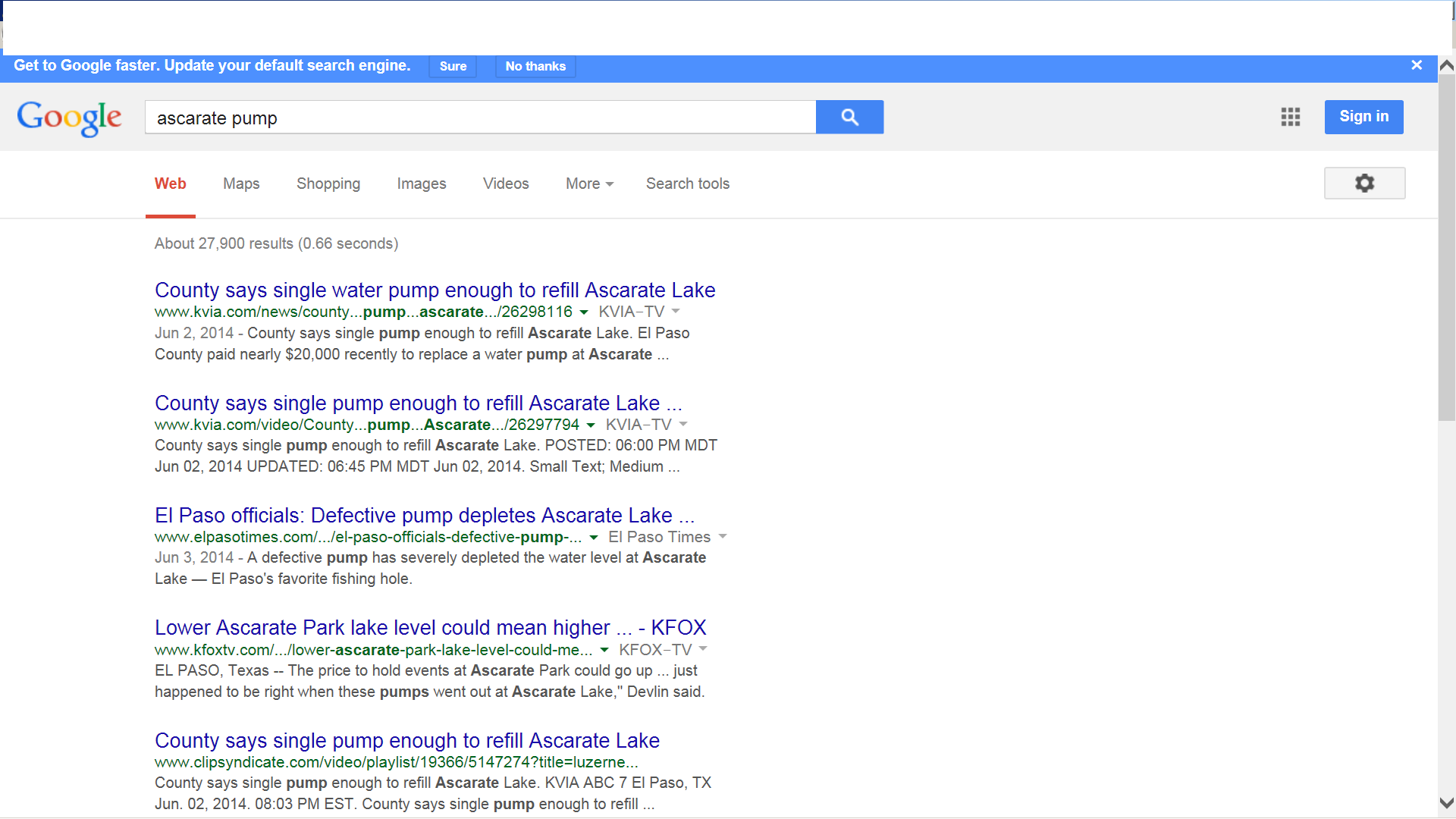
Not wanting to give up, I went to google and entered “Ascarate pump” with the following results:

ascarate3

The third item listed indicates that the Times did publish an article on June 3, 2014 about a defective pump at Ascarate.

I don’t know if the search capabilities at the Times site are misleading because they, like the city, want to hide past events or if this is just another example of incompetence.

We deserve better

Brutus