A reader criticized the blog this week writing “Guess because there is such hatred toward the city manager and certain city reps on this blog there is no way possible for anyone to advance a counter argument.”
Cato had posted Proposed charter amendments where you can read the exchange.
I commented that I had not seen any hatred at all on the blog. We go out of our way to focus on issues, not the individuals involved.
I try to focus on actions and behavior, not personalities. A long time ago I learned that I am the one who loses the most if I hate someone.
I think that if I spend some time writing about the kinds of actions that I am concerned about, some may come to better understand the issues.
In that spirit let me start with this email (left click on it to make it larger):
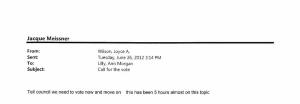
What we have here is an email from the city manager to the mayor pro tempore June 26, 2012 at 3:14 PM. That was during a city council meeting. The mayor was not there. The discussion was about the proposed ball park and the issues surrounding it. Many members of the public wanted to speak and have city council consider their views.
The city manager is telling, not asking, the mayor pro tempore “tell council we need to vote and move on”.
Our city charter makes the city manager “responsible to the Council for the administration of all City affairs placed in the Manager’s charge by or under this Charter”.
The city manager works for city council. The city council works for the voters. The city manager is not elected. The city manager should not tell council what to do. It must be the other way.
The city manager is a city employee. City council is a legislative body. The charter says council “shall have legislative powers, and the power and duty to select, direct, and regularly evaluate the City Manager …”.
Council is in charge. The proper position of the city manager is to ask, and advise, not tell.
At 5 hours and 30 minutes into the recording we hear the mayor pro tempore say “This is the end …” just as she was told to do.
Secret discussions
Also troubling is that we have proof that city council members use electronic devices to communicate during meetings of city council that are supposed to be open. Current Texas law does not specifically prohibit this practice, but in my opinion it should. The courts do too, I quote from Tal Kopan’s post when the Texas supreme court refused to hear a case that would have invalidated provisions of the Texas Open Meetings Act:
In 2005, two Alpine, Texas, city council officials were indicted for violating the Texas Open Meetings Act over emails they exchanged, which the government argued constituted a closed meeting. Though charges were later dropped, some of the officials involved in the email exchange sued, saying the act was a restriction of free speech, overbroad and vague.
The district court and circuit court both upheld the statute, rejecting the plaintiff’s claims.
The three-judge panel of the Fifth Circuit held that not only is the law content-neutral and constitutional, it also serves an important purpose for open government.
“Here, government is not made less transparent because of the messages of private speech about public policy: Transparency is furthered by allowing the public to have access to government decisionmaking. This is true whether those decisions are made by cogent empirical arguments or coin-flips. The private speech itself makes the government less transparent regardless of its message,” opinion from Judge Jerry Smith stated.
Attorney General Greg Abbott, who defended the act, issued a statement praising the Supreme Court’s move to let the lower court ruling stand as a win for open government.
“Open, transparent government is fundamental to our democratic system of government. Today’s decision ensures that the Texas Open Meetings Act will continue holding elected officials accountable to conduct the taxpayers’ business in the light of day and in a manner that informs the public about government decision-making,” Abbott said.
As is customary, the Supreme Court did not offer any reasoning for its refusal to hear the case.
We deserve better — in this case we got it
Brutus


 Posted by Muckraker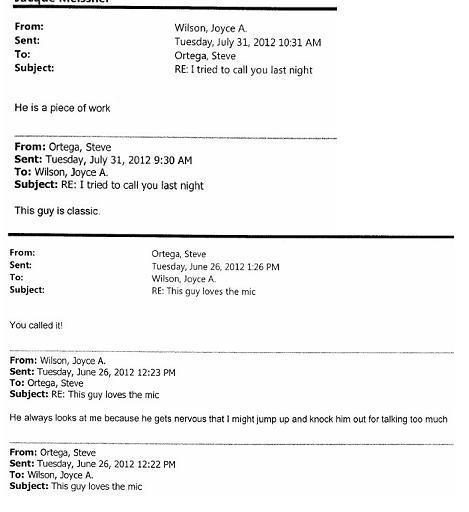


 elpasospeak
You must be logged in to post a comment.