EL PASO – AFFORDABLE STEPS TO RENEWAL #3

January 3, 2015

This is from Jerry Kurtkya:

EL PASO – AFFORDABLE STEPS TO RENEWAL

# 3 – Socialize the Benefits of Growth

I have been outlining the local game that has been played out for years now which is to privatize the benefits of El Paso’s growth while socializing its costs onto the tax base. My ideas have included several low cost strategies to instead privatize the costs of growth and save the land as an environmental resource.

In this installment, I will emphasize that the city needs to see its way through to creatively recapturing the now socialized costs of development with fees that pay for the ancillary costs of development, e.g., parks and libraries and public safety. The recent “victory” of the Builders Association in city council effectively removes much of the master planning initiative instituted by a prior council. As a result, the PSB will go back to the bad old days of piecemeal lot sales and development, endangering not only our future water supply, but the natural environment, too.

Whether there is master-planned or piecemeal development, the city has to find a way to force builders to pay for the costs of development that will otherwise be loaded onto the taxpayer. If we’re going to have growth, then let’s find a way to socialize its benefits instead of privatizing them as the current model does. The council’s recent decision to allow the Monticello development to assess fees to property is one example of how this can be done using a private sector model.

Impact fees, as previously described, are difficult in Texas because such fees are explicitly identified to incremental development, i.e., the city has to use the fees for their intended purpose or risk recapture by the builder. This is only fair but it requires a level of planning-to-action that city hall is incompetent to do. Need I say, “San Jacinto Plaza?” Then again, can you imagine the outcry from the builders if realistic impact fees of $10K to $20K per lot were charged? The impact fee route may not be politically feasible here.

But another form that we could consider is for the PSB to levy a surcharge on property sales that is not specific to ancillary infrastructure, as with impact fees. In this scenario, the PSB could simply estimate the number of housing units that might be built on a parcel and add, say, $20K per unit to the price of the property. Since the PSB owns the property being sold, they are just asking the purchaser to pay a higher price on a take-it-or-leave-it basis, not as an impact fee. This “extra” money can then be deposited into a fund for the city to use for the otherwise unfunded infrastructure, but not specifically tied to the sold parcel and, hence, not legally an impact fee. I hope.

Whether with higher impact fees or a PSB surcharge this is what has to be done in some form or we just keep getting poorer in spite of our growth as costs are transferred from builders onto taxpayers. Will housing costs go up? Of course, but that is not a bad thing. Housing is too cheap here now because of massive overbuilding for many years.

Finally, I have a cynical take on why the council deconstructed the PSB’s master plan strategy and it is more than just campaign contributions from the builders. Several on council, namely Niland and Acosta, have political ambitions beyond their current offices. They will soon be facing the reality of rising city taxes to pay for all the luxuries they voted for in the stadium, downtown spending, bond issue and trolley (its operating cost), in addition to the continued giveaway of tax abatements. This is not going to sit well with the voters, so how do they pay for these things without raising taxes?

How about forcing the PSB to sell its land and the city pocketing all the proceeds? IMHO, that is what the current strategy is moving toward and why the council’s hostility toward the PSB. They, and especially Rep. Niland, are looking for a way to force the sale of PSB lands to fund their spending spree as it hits the tax roll. This is like selling the family ranch to pay off the credit cards but not stopping the spending binge. If the city can capture the revenues from sale of PSB land, the coming credit card bill is not so scary. Look for more efforts in the near future to merge the PSB back into the city.

What do you think?

NEXT – #4 A Public Sector Bank


Nor any drop to drink

January 1, 2015

We start off the new year with a post from a new (to us) author Helen Marshall but not until we take the opportunity to wish you a healthy and prosperous new year and to thank all of you for your involvement.


What, us worry?

The Times has recently printed a series of articles that described various aspects of the drought facing the region and questions of how to continue supplying adequate water to the city. El Paso Water Utilities has also embarked on a campaign to convince us that, while water supply is not a simple matter any longer, “purified water” – i.e., recycled sewage – along with water piped from Hudspeth County, will ensure “Water Forever” as the EPWU slogan has it.

UTEP Economics professor Tom Fullerton ran a three-pronged offense over the weekend of December 27-18, to reassure everyone that “EPWU has met the challenge of providing quality water services in El Paso’s desert environment while operating efficient, reliable facilities that keep pace with the city’s growth. . [P]rudent management, continued planning, and innovative technologies will yield long-term solutions that benefit the local economy, environment, and quality of life.”

All three local papers printed his column, a first as far as this writer knows. Readers presumably are reassured that El Paso can continue growing, and water will be provided (at a reasonable price, yet!).

While the EPWU has indeed led the way on conservation in Texas and the region, we have yet to hear how much growth we can continue to shove into the Paso del Norte (where the neighboring city uses the same aquifer), regardless of the projected continuing drought. (Fullerton does not address the river that is missing for much of the year as its waters largely disappear into the pecan farms and cotton fields.) How much water is being removed from the aquifers and not returned now? How much worse will this be when we are drinking our “recycled water” rather than using it for recharge? As we carpet the desert with impermeable parking lots and structures, how much worse does the flooding problem become? Perhaps we must just learn to live next to the Big Ditch and not worry about that part of our quality of life. And the good news is that there will be an ever-larger supply of attendees for the Ballpark!

If we buy this story, do we deserve better?

http://www.elpasotimes.com/water

http://www.elpasoinc.com/news/local_news/article_a436c3ca-8f76-11e4-aa76-c3ace90cf2e0.html

http://www.elpasotimes.com/opinion/ci_27217287/el-paso-water-utilities-is-planning-leader

http://diario.mx/Opinion_El_Paso/2014-12-27_521b96a7/epwu-la-eficiencia-en-el-desierto/


New cost containment technique

December 31, 2014

A couple of weeks ago we heard about the west side pool project being delayed because of under-funding.

The quality of life bonds that we passed allocated $8 million to the pool and now the architects are telling us that the cost will be in excess of $13 million.

Word on the street is that many of the quality of life projects were underfunded.  The story is that our former city manager did not engage construction professionals in the estimating process.  She and her colleagues evidently decided how much everything should cost.  A five million dollar miss on an eight million dollar project sounds like something that our former chief financial officer could have come up with.

Then city council gave us a potential answer to the problem when they voted not to put restrooms in San Jacinto Plaza.

Should we build the west side pool without restrooms?

After all …

We deserve better

Brutus


Chamber’s latest

December 27, 2014

I got a copy of the 2015 issue of Livability:  Greater El Paso, Tx in the mail yesterday.

The magazine is sponsored by the Greater El Paso Chamber of Commerce.  The wrapper it was in had this statement:  “We are pleased to provide this complimentary copy of our primary fulfillment piece for newcomer/relocation information requests.”  At last a chance to see how the chamber helps promote new business.

The cover featured a handsome picture taken from the inside of our new ball park.

Some of the facets of our community that the magazine featured were:

“Exciting new projects are under way in El Paso’s downtown, which already serves as the epicenter of its art and entertainment scene, with a new ballpark, theaters, museums, main library and arts organization offices.”

They wrote about our All-America City Award in 2010 and about El Paso being the nation’s safest large city four years running.

Our 300-plus days of sunshine were mentioned.

Wonderful voters

“The $74 million ballpark is part of a $473 million quality-of-life bond measure that local voters overwhelmingly approved in 2012” according the magazine.  Most of us missed that election.

Public schools

“Three public school districts serve the El Paso region.”  They mentioned the El Paso, Socorro, and Ysleta districts.  Maybe the chamber considers the Canutillo district to be outside of our region.

Well developed

The “Business Spotlight” featured Jordan Foster Construction, Texas Gas Service, River Oaks Properties, Mimco Inc. and Hunt Companies Inc.

My favorite quote was “From an economic development standpoint, people look for predictable operating environments…And that is what we offer in El Paso”.

No kidding.

We deserve better

Brutus


Really, really special

December 22, 2014

Well they’re still at it.

The city council vote to not put restrooms in the eventually to be finished San Jacinto Plaza got me to thinking about how I could have missed notification of such an agenda item.  I went to the city’s web page and searched for the agenda item.  It was nowhere to be found.

I did find this document which is the report of the minutes of a special city council meeting that was held on Monday, December 15, 2014.

epcc12152014specialcouncilminutes

Huh?

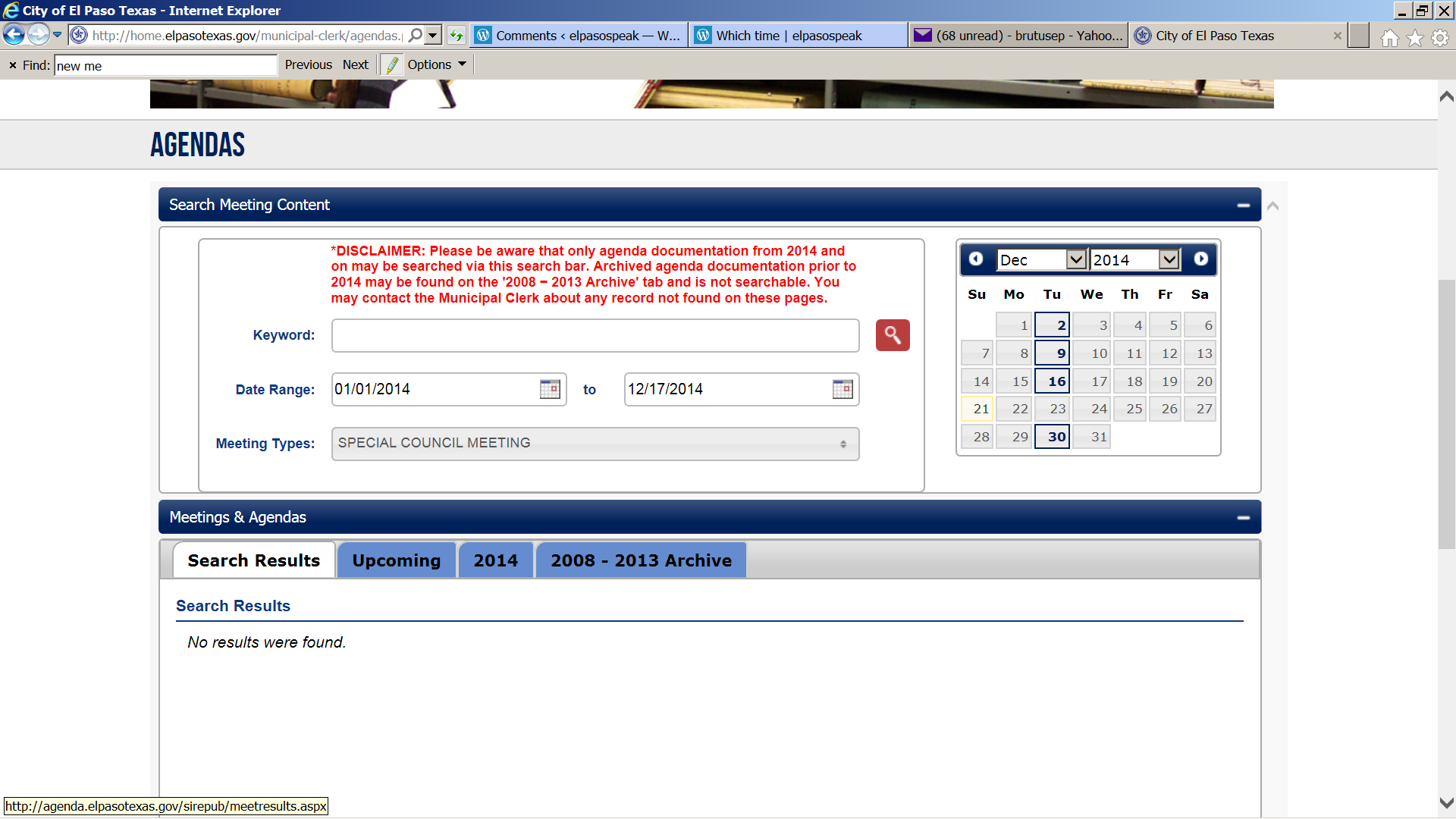
They held a special city council meeting on Monday, December 15, 2014.  Where was the required public notification that the meeting was to be held?  Back at the city web site this is what showed up when a search for any special meeting in 2014 was entered:

epccspecialmeetingssearch12172014

State law requires council to post notification of any council meeting 72 hours before the meeting “in a place generally accessible to the general public” unless there is an emergency.

Our courts have ruled that posting notification on a bulletin board outside of city hall fulfills the requirement.

A reasonable citizen would probably conclude that the city posts it’s special council meeting notices on the city web site along with the regular meeting notices.  Why else would the drop down box have a provision for searching for special council meetings?

The trick here is that the city can comply with state law by posting an agenda on a bulletin board while tricking us to believe that they will post the notice on their web site.  No notification, no pesky public.

By the way, council had another special city council meeting on Tuesday, December 16, 2014.  The regular city council meeting was adjourned at 11:52 on that day and the special meeting was convened at 12:08 in a different room at city hall.  I guess they could move the entire council away from the public in only 16 minutes because they have restrooms at city hall and don’t have to go next door to use some business person’s facility.

Adding insult to injury, the special city council meetings are not video recorded and made available for the public to view after the fact.

This is disgraceful and mean spirited.

We deserve better

Brutus