I found this chart on city-data.com:
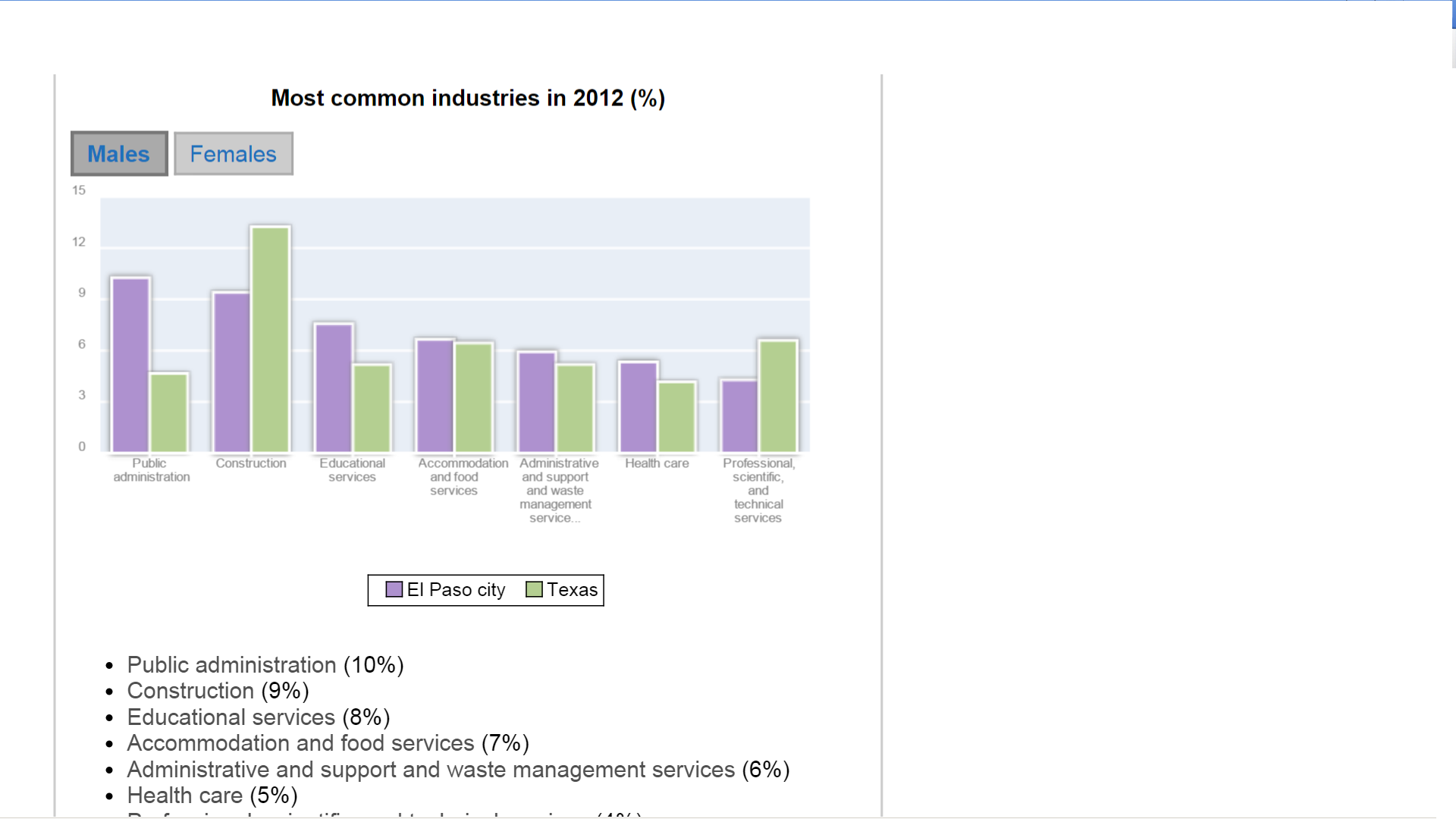
Take a look at the bars on the left. The data for females also showed higher percentages of people involved in public administration here in El Paso than in the rest of the state.
We deserve better
Brutus
I found this chart on city-data.com:
Take a look at the bars on the left. The data for females also showed higher percentages of people involved in public administration here in El Paso than in the rest of the state.
We deserve better
Brutus
 3 Comments |
  City government, County Government, El Paso Independent School District, Federal Government, State Government |
  Permalink
 Posted by Brutus
El Paso Inc. wrote in their Monday, September 22, 2014 post (www.elpasoinc.com) that Uber is now operating in El Paso.
Uber is a jitney service where people can use their smart phone to arrange a ride instead of taking a taxi. Users say that the service is quicker and more convenient than using our traditional taxi companies.
Part of the Inc. post included this:
“I’m all for it,” said city Rep. Claudia Ordaz, City Council’s newest and youngest member. “I think this is a good opportunity for the city to look at the vehicle-for-hire-regs and maybe revamp them so that services like this can abide by the rules.”
Our city representative says that she’s all for the new service, even though it appears to be illegal to do this in El Paso.
Many of our elected officials seem to have difficulty remembering that our laws must be obeyed. If we don’t like them we should change them. If this service is truly illegal in El Paso, then what she said is irresponsible. A better response might have been “the City needs to look into how we want to handle this. I think that I would vote for an ordinance that would allow Uber to operate legally”.
Instead what we saw was a city representative once again deciding that they have the authority to violate or encourage others to violate our laws.
We deserve better
Brutus
8 Comments | City government, County Government, El Paso Inc. | Permalink
Posted by Brutus
I find irony in the fact that the city is trying to restrict access to payday lenders while the county has become a payday borrower.
The people in charge of our county hospital have let it get into such bad shape that they need to borrow money now against next year’s property tax income.
According to the Times, things have gotten so bad over at the hospital that the hospital needs to borrow $20 million from next year’s $69 million in property tax income. That’s 30 percent of their paycheck. Try that yourself.
According to hospital management if they are not allowed to borrow the $20 million they will lose out on $45 million from the feral government. Evidently even the feds have financial standards — ones that we will not meet unless we take the payday loan.
Management wants to borrow the money now and pay it back February 28, 2015. The cost will be $75,000, two thirds of it will be interest and one third loan origination costs.
Any one of us that told our bank that we need to borrow 1/3 of our salary for five months in order to make ends meet would be told no. Not only no but let’s call your current loans since you are obviously in deep trouble and we might not get any of our money back.
It looks like our county hospital does not have to operate with a balanced budget. Evidently they are allowed to borrow money against next year’s tax income. What will happen if the city starts to use this technique? Is this a new way to mortgage our futures?
We deserve better
Brutus
2 Comments | City government, County Government, El Paso Times, Federal Government | Permalink
Posted by Brutus
This from Jerry Kurtyka:
EL PASO – GAME’S OVER
# 5 – What Do We Do Now?
Things are going to slide, slide in all directions
Won’t be nothing
Nothing you can measure anymore…
Leonard Cohen, The Future
If Brutus continues to indulge me, I want to discuss some ideas that have been brewing over the last three years as I completed the broad band project (BTOP) for the Library. I said earlier that I would redeem the cheap shot I took at Richard Florida’s expense, because he does have something to say on this matter. To paraphrase Florida, urban planners assume that, to attract talent/jobs, what’s important is to provide infrastructure: sports stadiums, freeways, shopping centers, etc. In fact, creative people prefer authenticity — so making your city just like everyplace else is a sure way to kill its attractiveness.
Sound familiar? Stadiums, trolleys, arenas. Since my arriving here in 1996, El Paso’s main problem to me, at least, has been its insularity, backwardness and apathy, not the lack of a trolley or arena. You know the joke, “You have landed in El Paso, please set your watch to 1974.” Few ever leave and even fewer people travel to return and tell us what the rest of the world is doing and thinking. When they do, we call them “crazies.” Otherwise, it’s the same people talking to the same people.
I really believe that El Paso and many other cities are now at a crossroad. It is clear that global urbanization will continue if for no other reason than cities are an efficient form of social and economic organization. When I wrote earlier about El Paso’s physical and economic growth, that is what I was talking about and it is the focus of our city leaders and the Borderplex types. It is all they can see and so they put all their effort into it. They want to do the things other cities tried 25 years ago.
It is also clear to me that the world is in the midst of a change in consciousness as radical as previous changes in the Renaissance, the Enlightenment and the Industrial Revolution of 200 years ago. These two trends – global urbanization and emerging consciousness – are not necessarily mutually reinforcing, either. There is an unrest afoot on the planet. If you’re not seeing it and feeling it, you are blind.
All over the world now, action communities are forming faster than they can be counted, usually focused on social and economic justice, peace and the environment. Tens of thousands of them! They have no central governance and only informal communication between them and no central dogma. Dogma and “isms” are so 20th century! They don’t want to kill each other. OCCUPY is one such group in this country, but more frequently these action groups involve indigenous peoples in the 3rd world and, especially, in South America. It is the consciousness of the planet speaking to us through the planet’s marginalized people. It is worth being a part of it.
Listen to this five minute speech given by Paul Hawken at the Bioneers Conference (https://www.youtube.com/watch?v=Xkz2OjMOg88 ) to hear what I mean. Now, imagine this unrest here in El Paso. Where are its seeds? Who would you ask about it?
First I will tell you who NOT to ask. Do not ask anyone in the Rotary Club, the Garden Club, the country club, Borderplex, or anyone on city council or in any bank or economics or planning department or the chambers. They are too baked into the current growth model and how to get their piece of it.
But you can ask yourself what matters in your city. What do you feel about your city and, also, notice where in your physical body you feel it: stomach, neck, head, heart, ears? When do you feel it? Who in you is feeling it? The teenager? The business person? The teacher? The parent? The taxpayer? The malcontent? What information is this giving to you; telling you about El Paso and your place in it? Are you going to do anything about it?
When I consider El Paso, I feel very angry and I want to do something about it instead of just watching the Usual Suspects feed their faces at the spend-and-tax trough, courtesy of the politicians and bureaucrats they own. I also get upset with the apathy of citizens here that enables this to exist as it does.
So, when I left city employment last year, we took a European tour and exactly one year ago I found myself attending the Urban Systems Collaborative (USC) conference at Imperial College in London (so I could write off the trip ). The USC focuses on the role played by information flows in cities and attempts to define a “science of cities” using constructs such as complex systems and social network theory. I had participated in this eclectic, hang-loose-group for a year and looked forward to finally meeting some of the people with whom I had been corresponding – urbanists; architects; computer scientists; physicists; academics; artists (yes); entrepreneurs; planners. Quite a mix!
Appropriately, the USC conference theme was Quality of Life, but it wasn’t about a bond issue. Rather it was about what makes for a quality life in the city; how it is that our cities can become the places that contain our lives and allow each of us to reach our potential. I will get into more specifics in future posts, if Brutus allows, and I will consider how Maslow’s Hierarchy can help to define an urban consciousness and point the way up and through to different kinds of cities that coexist simultaneously in the same space; with or without trolleys and stadiums.
9 Comments | Ball park, City government, County Government | Permalink
Posted by Brutus
Bear with me please, we are going to do a little bit of arithmetic here. Getting numbers in one place for the El Paso situation has been a challenge.
Several of our local politicians are complaining that our homeowners are shouldering an unfair part of the property tax burden. Businesses are getting an unfair break according to them.
According to this article in El Paso Inc. local commercial properties were valued a $6.4 billion by the central appraisal district last year. We have been told that commercial values are flat this year.
The county placed the total value of property in the county at $36.1 billion for their 2014 tax year.
That makes the appraised value of commercial property at about 1/6 of all property.
El Paso is frequently compared to San Antonio as being a place that we should aspire to be more like, success wise.
This article in the San Antonio Express-News tells us that Bexar county’s commercial property values are “about $21 billion” out of their total valuation of $120.6 billion.
That’s about 1/6, just like us.
Now let’s look at the tax rates in the two cities for 2013:
San Antonio’s city tax rate is .56569 per hundred dollars of valuation while El Paso was at .6783 per hundred. We are 20% higher.
Bexar county was at .296187 while El Paso county was at .4331. We are 46% higher.
The San Antonio school district came in at 1.3576. Our Ysleta district has the highest rate of the school districts in the city. Their number was 1.36 per hundred, virtually the same as San Antonio. EPISD came in at 1.235.
Bexar county properties are valued at 3 1/3 times greater than El Paso county’s. The 2012 population of Bexar county was 1.786 million people while El Paso county’s was 644,964 making Bexar about 2.8 times more populous than El Paso.
Many arguments can be made as to why Bexar has a larger tax base. Unfortunately we are still left with the fact that we in El Paso had the 7th highest tax rate among the top 50 cities in the United States in 2013. That is before the bill for the downtown projects and the quality of life bonds adds even more.
The new city manager was quoted recently about how “wants” somehow become “needs” in El Paso.
Maybe if we started to live within our means and elected competent government officials we would have a better chance of attracting businesses to town.
One thing is certain however. At least when compared to San Antonio our businesses are paying the same share of the tax burden.
We deserve better
Brutus
5 Comments | City government, County Government, El Paso Inc., El Paso Independent School District | Permalink
Posted by Brutus
You are currently browsing the archives for the County Government category.

 elpasospeak
You must be logged in to post a comment.